9 min read
How Long Does Meth Stay in Your System? Detection Windows for Urine, Blood, Saliva, and Hair
How long does meth stay in your system? Detection windows for urine, blood, saliva, and hair, plus what affects the timeline and when to get help.

Medically reviewed by Dr. Asad R. Hussain, M.D.
Board-certified psychiatrist · Medical Director · Last reviewed
TL;DR
How long meth stays in your system depends on the test. Blood has the shortest window (hours), urine is longer (about 1 to 3 days for drug tests in general), and hair is the longest.
Saliva tests detect meth for a shorter time than urine tests do.
Heavy use, dose, kidney function, and urine chemistry can all move the timeline. No one can give you an exact number.
Water, detox drinks, and exercise are not reliable ways to clear meth. Labs also check for tampering.
If you are asking this question because meth use is getting out of hand, medical help is available, and you do not need to be "bad enough" to ask for it.
Table of Contents
Introduction
You are probably asking how long meth stays in your system because something is coming: a drug test, a court date, a job, a conversation with someone who loves you. Or maybe you are a parent or spouse trying to understand what a result means.
This article gives you the straight answer, including the parts that are uncertain. It also explains why the same dose can show up differently from person to person, and what to do if the real question underneath is "can I stop?" At Double Peak Recovery, we answer that second question every day.
How long does meth stay in your system? A quick overview
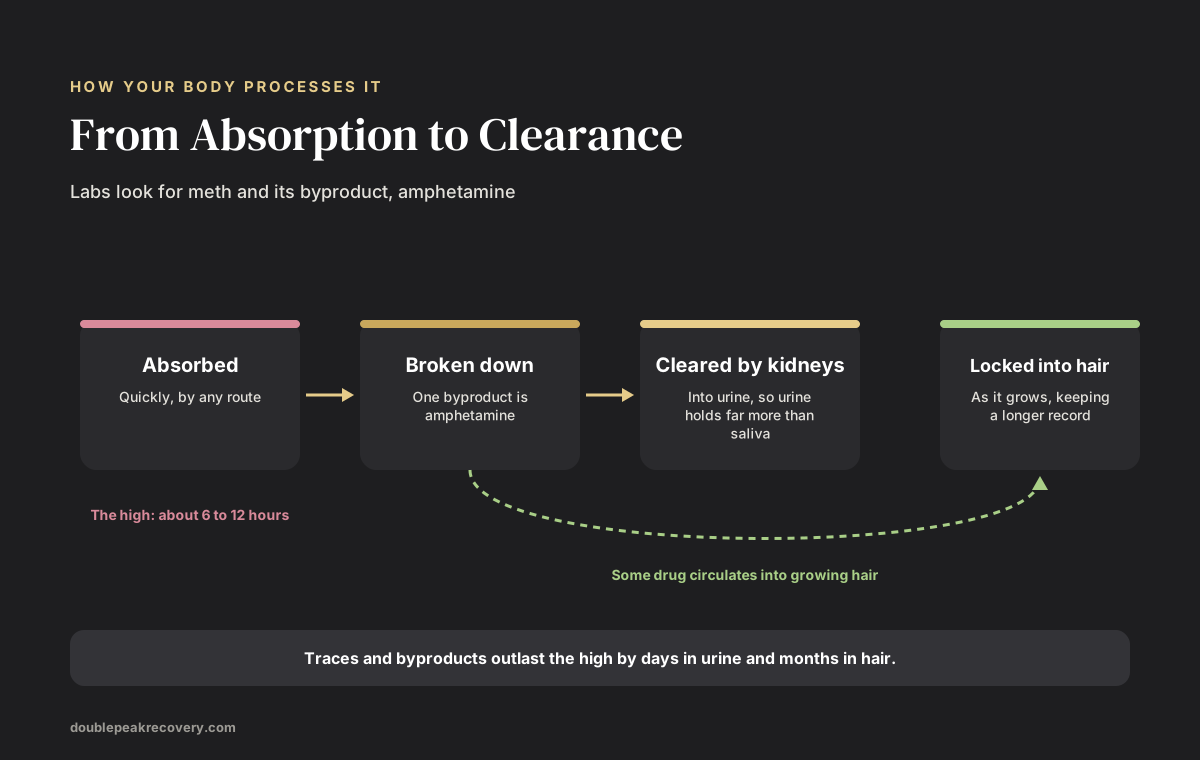
There is no single number. How long meth stays in your system depends on which sample is tested, how much you used, how often, and how your body handles it. Methamphetamine itself acts for about 6 to 12 hours, but traces of the drug and its byproducts last much longer than the high does.
Think of it in layers. Blood catches the shortest stretch. Urine catches a few days. Hair can reach back for months. The next section lays out each one.
Meth detection windows by test type: urine, blood, saliva, and hair
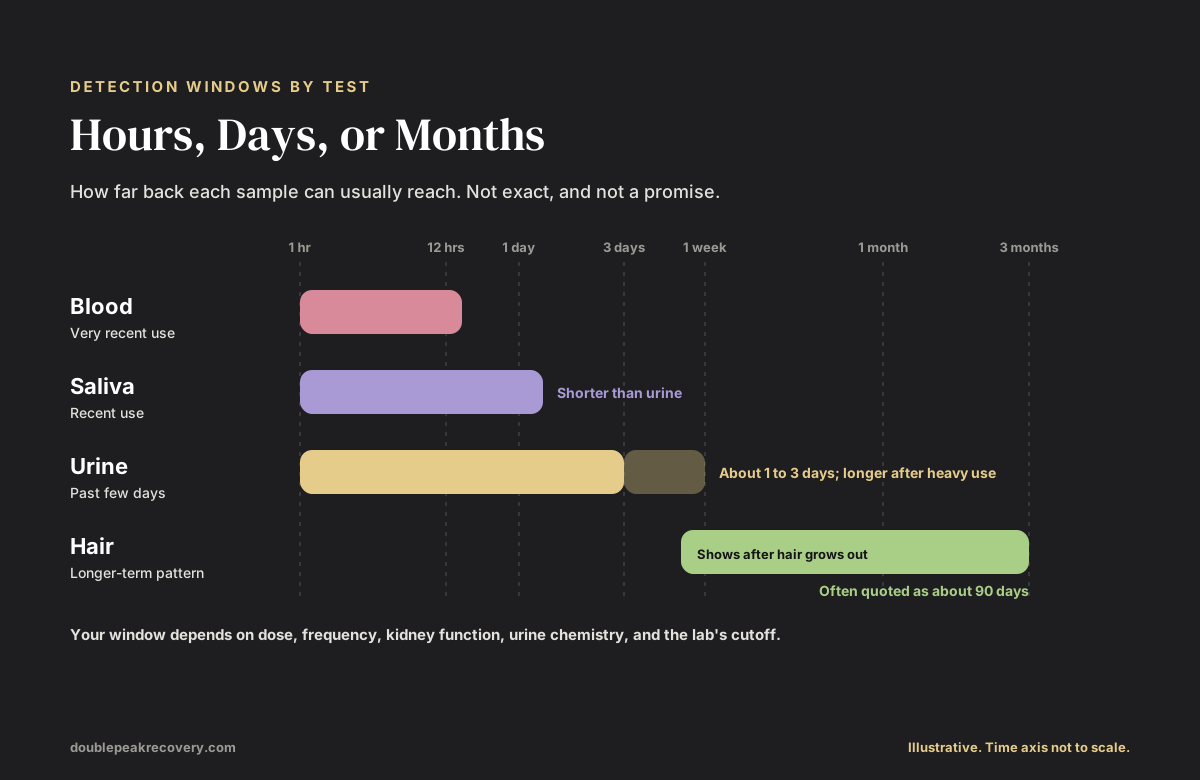
Here is how the four common samples compare. The urine and blood figures describe drug testing in general, not meth alone, so treat them as a starting point.
Test type | Typical window | What it tells you |
|---|---|---|
Blood | Several hours | Very recent use |
Urine | About 1 to 3 days | Use in the past few days |
Saliva (oral fluid) | Shorter than urine | Recent use |
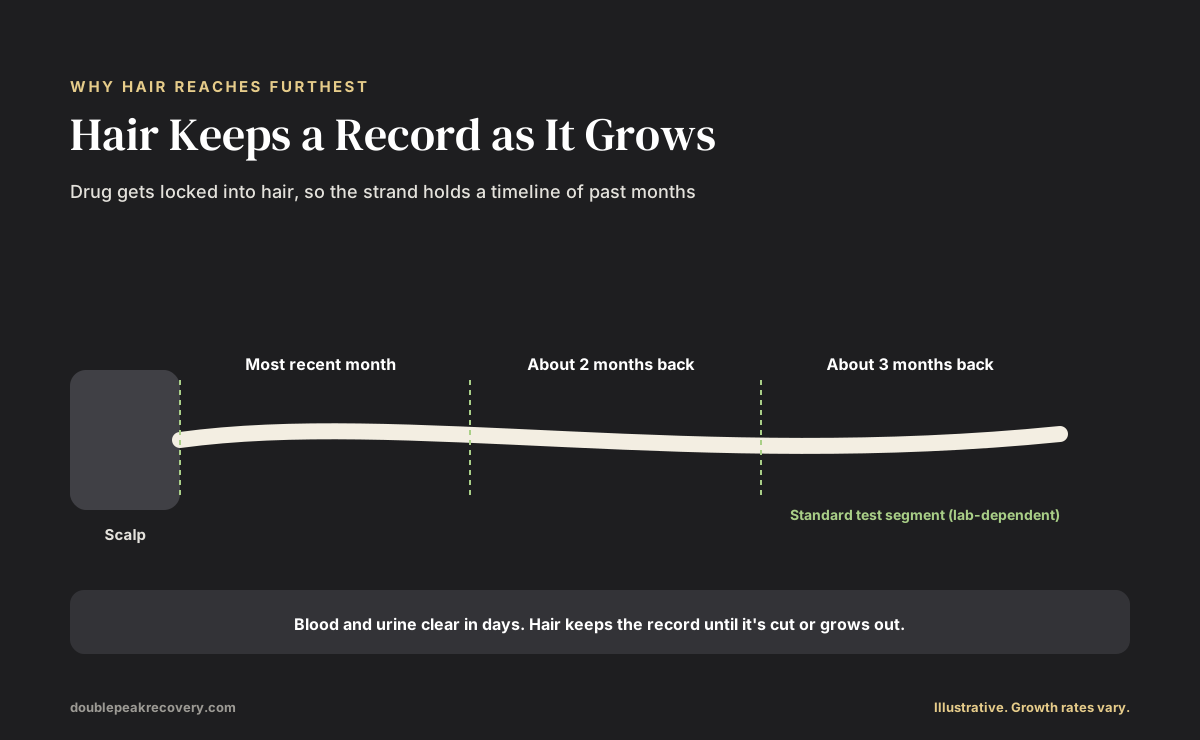
Hair | Months (often quoted as about 90 days) | Longer-term pattern of use |
Urine
Urine is the most common test. Compared with blood, it has a wider window, roughly 1 to 3 days, and it is easy to collect, which is why many programs use it as the standard.[1] In a controlled dosing study, meth levels in urine were substantially higher than in oral fluid, and urine detection times were generally longer.[2] After heavy or repeated use, a urine test may stay positive longer than a few days.
Blood
Blood has a window of several hours.[1] It is rarely used for routine screening. You are more likely to see it in an emergency room or after an accident.
Saliva
Saliva, also called oral fluid, is simple to collect while someone watches, which makes it harder to cheat. The tradeoff is time. At standard cutoff levels, meth was detectable for a shorter period in oral fluid than in urine.[2] A 2026 study of fifty people who used amphetamines found oral fluid tracked recent use well.
Hair
Hair holds onto drugs far longer. In that same 2026 study, hair had the highest amphetamine concentrations of any sample, and the authors called it the best option for long-term detection. In a study of 91 children exposed to meth at home, hair testing found drugs in 77.8% of cases, urine in 22.1%, and oral fluid in 6.9%. The "90 days" figure is a common rule of thumb for standard hair tests. The exact reach depends on the lab and how much hair is collected.
How your body processes methamphetamine
Meth is absorbed quickly whether it is smoked, injected, snorted, or swallowed. Your body breaks it down, and one of the byproducts is amphetamine. Labs look for both the meth and that byproduct.
Your kidneys then clear it into urine, which is why urine holds so much more of the drug than saliva does. Some of the drug also gets locked into hair as it grows, which is why hair keeps a record long after the rest has cleared.
Factors that affect how long meth stays in your system
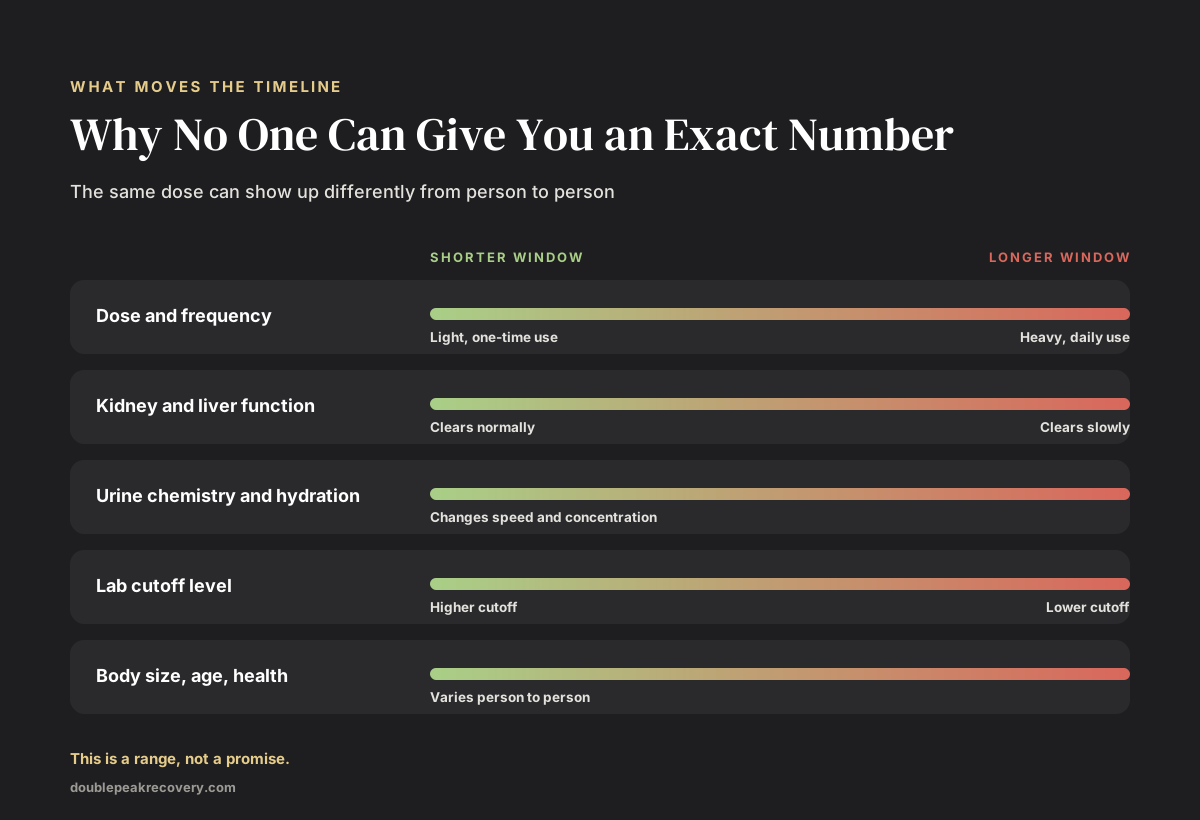
Two people can use the same amount and get different results. Here is what moves the timeline:
Dose and frequency. In the dosing study, some drug built up with daily use, though it did not markedly change detection times for oral fluid tests.[2] Heavier, longer use generally gives a longer tail in urine and hair.
Kidney and liver function. Slower clearing means a longer window.
Urine acidity and hydration. Both can change how fast meth leaves the body and how concentrated a sample is.
Cutoff level. Each lab sets a concentration below which a test reads negative. A lower cutoff catches use for longer.
Body size, age, and general health.
This is why anyone who gives you an exact number is guessing. How long meth stays in your system is a range, not a promise.
Can you speed up meth elimination? Myths vs. reality
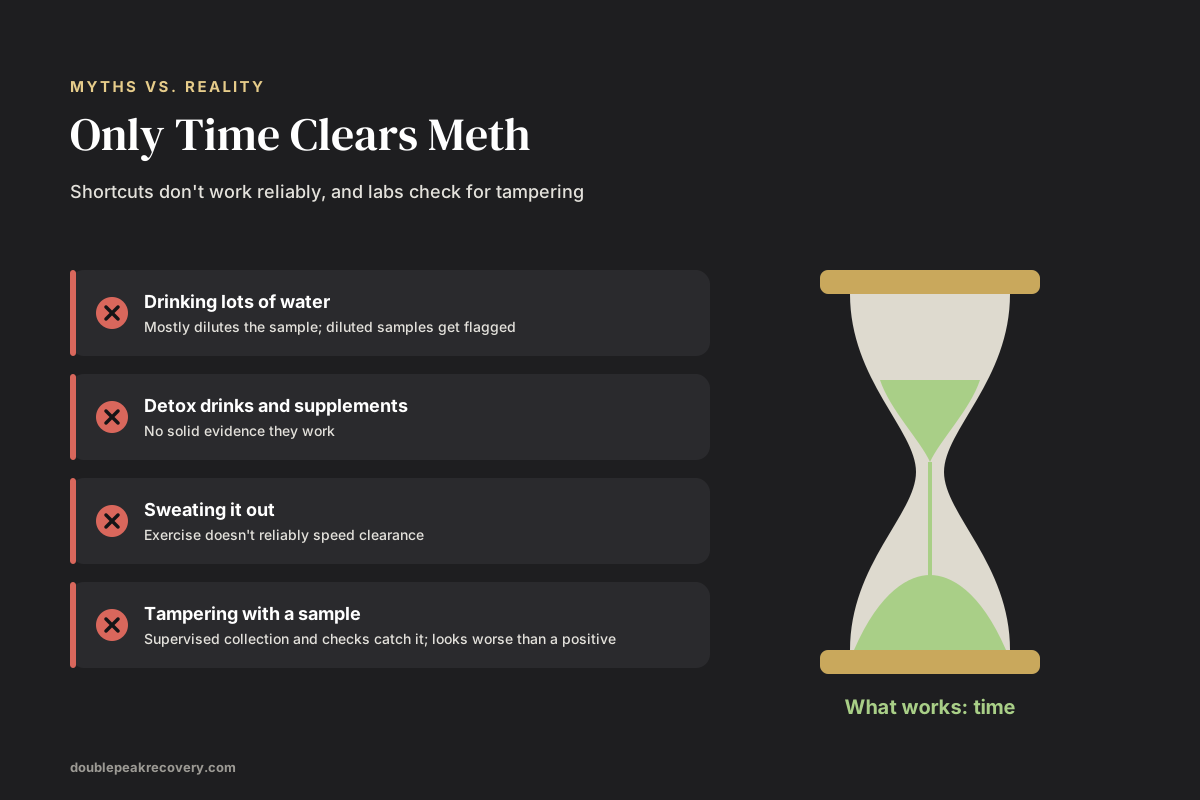
Not reliably. Drinking a lot of water mostly dilutes a urine sample. Labs check for that, and a diluted sample can be flagged or require a retest.[3] Detox drinks, supplements, and sweating it out at the gym have no solid evidence behind them.
Tampering is worse. Dilution, adding chemicals, and swapping in someone else's urine are the known ways samples get altered, and programs use supervised collection and sample checks to catch them.[4] A flagged sample usually looks worse than an honest positive.
What does work is time. If you have stopped, waiting is the only thing that clears meth.
Meth withdrawal and what to expect after last use
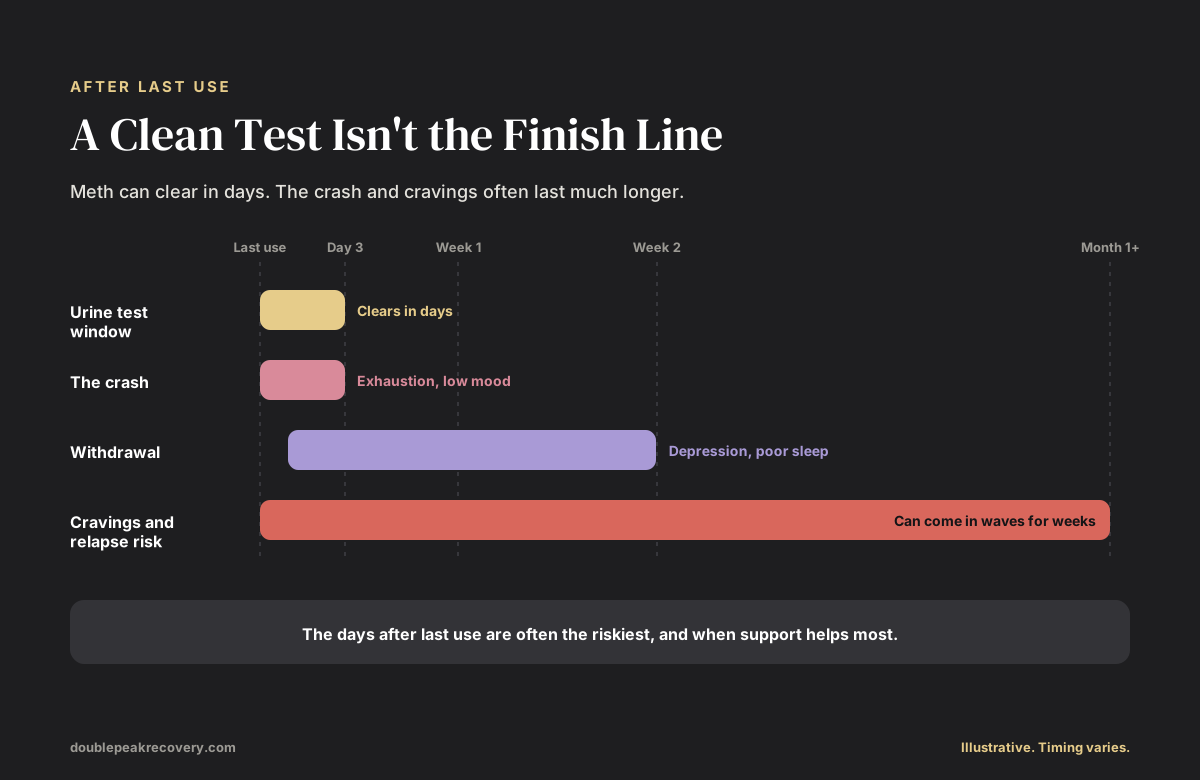
Once the drug leaves your system, your body has to adjust to its absence. Many people feel a heavy crash first, with exhaustion, low mood, and strong cravings. Our guide on how long meth withdrawal lasts walks through that timeline in detail.
A clean test does not mean the hard part is over. The days after the last use are often when people are most at risk of returning to meth, and when support helps most. If you want to know what supervised care looks like, see medical detox timelines or our meth and cocaine detox page.
When to seek professional help for meth use
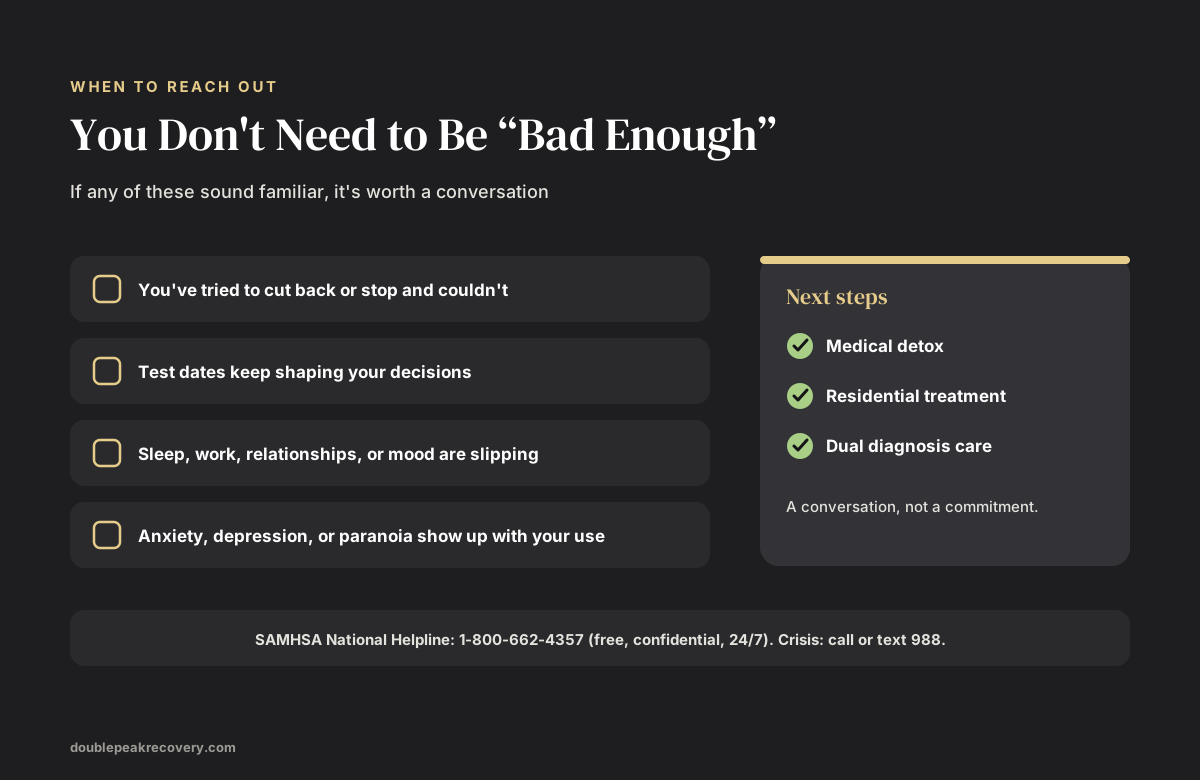
Consider reaching out if any of these sound familiar:
You have tried to cut back or stop and could not.
You keep searching how long meth stays in your system because testing keeps shaping your decisions.
Sleep, work, relationships, or your mood are slipping.
Anxiety, depression, or paranoia show up alongside your use.
Double Peak Recovery is a small residential program in Escondido, California. We offer medical detox, residential treatment, and dual diagnosis treatment when mental health and meth use are tangled together. You can see how the steps fit on our levels of care page. Cost is a common worry, so we also wrote about ways to pay for rehab.
Frequently Asked Questions
Q: How long does meth stay in your urine after last use?
A: Urine tests generally pick up drug use for about 1 to 3 days.[1] After heavy or frequent use, meth can stay detectable in urine longer. Lab cutoffs and your own body also change the result.
Q: Can meth be detected in hair for up to 90 days?
A: Yes, 90 days is the commonly quoted reach of a standard hair test, and it can sometimes be longer depending on the lab and hair length. Hair holds the highest concentrations of amphetamines among the sample types studied and is considered the best for long-term detection.
Q: Does heavy or long-term meth use make it stay in your system longer?
A: Generally, yes. Some drug accumulation was seen with daily dosing in a controlled study, though it did not markedly change oral fluid detection times.[2] Heavier use tends to extend how long meth stays in your system in urine and hair.
Q: Do detox drinks, water, or exercise help you pass a meth drug test?
A: Not reliably. Extra water can dilute a urine sample, and dilution is one of the tampering methods that testing programs watch for. Only time clears meth.
Q: Can a drug test show a false positive for methamphetamine?
A: It can happen. Screening tests can react to other substances, which is why a positive result is usually confirmed with a more precise lab method. Results can also be misleading if they are not read in the right clinical context. Tell the person reviewing your result about every medication you take.
Conclusion
So, how long does meth stay in your system? Hours in blood, a few days in urine, less time in saliva than in urine, and months in hair. Your own number depends on how much you used, how often, and your body. Waiting is the only thing that clears it.
If you are tired of living around test dates, you can call Double Peak Recovery and talk to someone about what comes next. Visit doublepeakrecovery.com to ask about admission.
References
Ontario Health Technology Assessment Series. Optimum Methadone Compliance Testing: An Evidence-Based Analysis. 2006.
Annals of the New York Academy of Sciences. Methamphetamine Disposition in Oral Fluid, Plasma, and Urine. 2007.
Federal Practitioner. A Practical Guide to Urine Drug Monitoring. 2018.
Analytical and Bioanalytical Chemistry. Advances in testing for sample manipulation in clinical and forensic toxicology - Part A: urine samples. 2023.